On this page
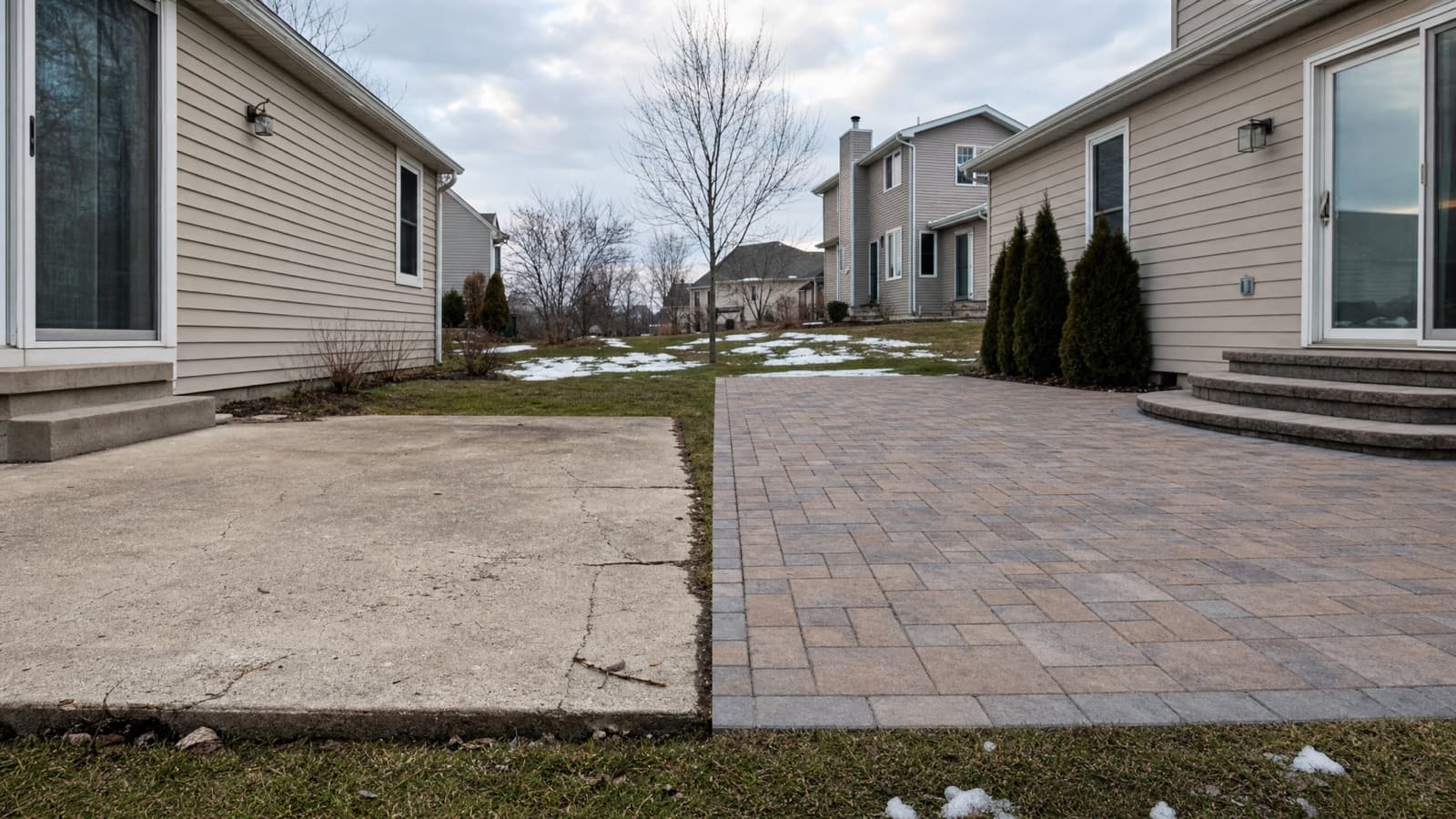
Walk any subdivision in Manhattan, Joliet, or New Lenox that's more than ten years old and you can run the experiment yourself: count the poured concrete patios and driveways with cracks, and count the paver installations with cracks. Around here, that's not a coincidence — it's chemistry and physics. Here's an honest comparison of the two, including the part where concrete wins.
The Upfront Cost (Concrete Wins)
No contest on day one. A basic broom-finish poured slab runs roughly $8-$14 per square foot in our area; stamped and colored concrete climbs to $14-$22. Pavers installed properly run $18-$30 per square foot (full breakdown in our Will County paver patio cost guide). If the plan is to sell the house within a couple of years and the patio just needs to exist, a clean poured slab is the rational budget choice.
The Freeze-Thaw Problem (Pavers Win, and It's Not Close)
Will County sees dozens of freeze-thaw cycles every winter — days that thaw, nights that refreeze. Water works into the soil and any surface pores, freezes, and expands about 9%. Do that fifty times a year on top of our heavy clay soil, which itself swells and shrinks with moisture, and every hard surface in your yard is being slowly flexed.
A poured slab is one rigid piece. It cannot flex, so it cracks — the industry's own saying is that there are two kinds of concrete: cracked, and about to crack. Control joints just try to pick where. Once a crack opens, water gets in, freezes, and widens it every winter. Add de-icing salt and you get surface spalling — the flaky, pitted look on so many local driveways.
A paver patio is thousands of small units on a compacted aggregate base with sand joints. The whole system is designed to move. Each freeze-thaw cycle, the surface flexes a fraction of a millimeter and settles back. Nothing cracks, because nothing is rigid enough to crack. This is why paver systems are the standard in Scandinavia and Canada — climates worse than ours.
Head-to-Head Scorecard
| Pavers | Poured concrete | |
|---|---|---|
| Upfront cost (per sq ft) | $18 - $30 | $8 - $14 ($14 - $22 stamped) |
| Freeze-thaw cracking | Flexes — doesn't crack | Will crack; joints only pick where |
| Repairs | Lift & re-set exact spot, invisible | Caulk, mudjack, or re-pour a mismatched patch |
| Maintenance | Top up joint sand occasionally | Seal every few years, no salt year one |
| Design options | Patterns, borders, inlays — unlimited | Broom finish or stamped patterns |
| Listing-photo test at year 5 | Still looks intentional | Crack reads as a future expense |
Repairs (Pavers Win Big)
When a slab cracks or a section settles, your options are ugly: caulk the crack and look at it forever, attempt mudjacking, or cut out and re-pour a section that will never match the original color. When a paver area settles (say, over a downspout drain that washed out), a contractor lifts those exact pavers, re-levels the base, and re-sets the same stones. An afternoon of work and the repair is invisible.
Maintenance (Roughly a Tie)
Neither is maintenance-free, whatever the salesperson says. Concrete should be sealed every few years, and salt should never touch it in year one. Pavers need joint sand topped up occasionally (polymeric sand stretches this to many years) and benefit from an optional re-seal if you want the color to pop. Weeds in paver joints are mostly a symptom of skipped polymeric sand — done right, they're rare.
Looks and Resale (Pavers Win on Most Streets)
This one is taste, but the market has an opinion: hardscaped outdoor living areas consistently rank near the top of exterior improvements for buyer appeal, and paver patios read as the premium product. Pattern, border, and color options are effectively unlimited, and a five-year-old paver patio still looks intentional in listing photos, while a five-year-old slab with a crack across it reads as a future expense.
The 15-Year Math
Take a 16x20 patio (320 sq ft). Poured slab: roughly $3,500-$4,500 upfront, plus sealing, plus — being honest about our climate — a meaningful chance of a crack repair or partial re-pour within 10-15 years. Pavers: roughly $6,000-$9,500 upfront, spot repairs measured in hundreds, not thousands, and no realistic scenario where you replace the whole thing. Concrete is cheaper to buy; pavers are usually cheaper to own. Which matters more depends entirely on how long you're staying.
Our Honest Bottom Line
- Choose poured concrete if budget is the constraint, you're selling within a few years, or it's a utility surface (a shed pad, a basketball half-court).
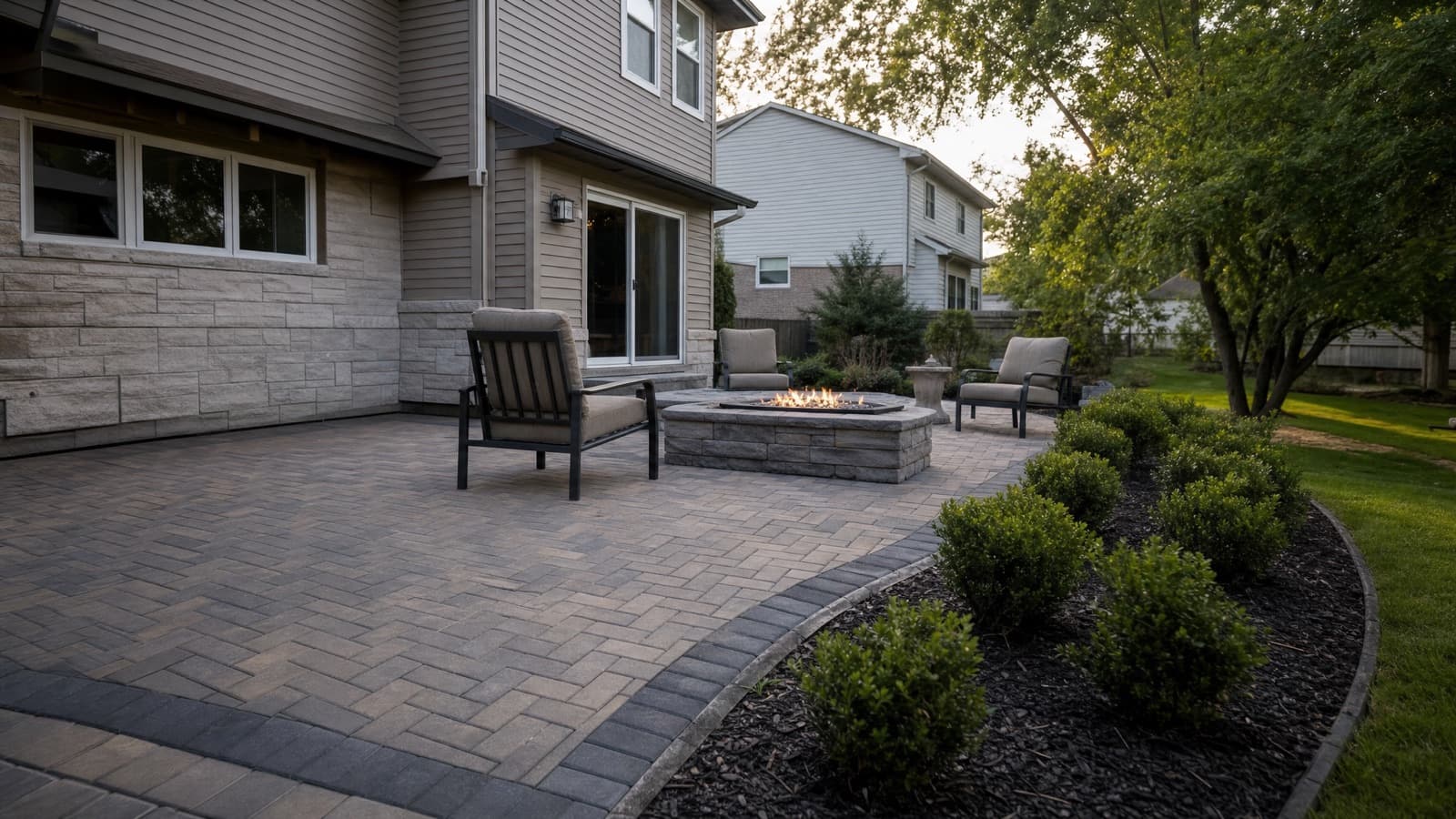
- Choose pavers if this is the backyard you're going to live in — if the patio is where dinner, the fire pit, and the next ten summers happen. In a freeze-thaw climate, it's the surface built for the job.
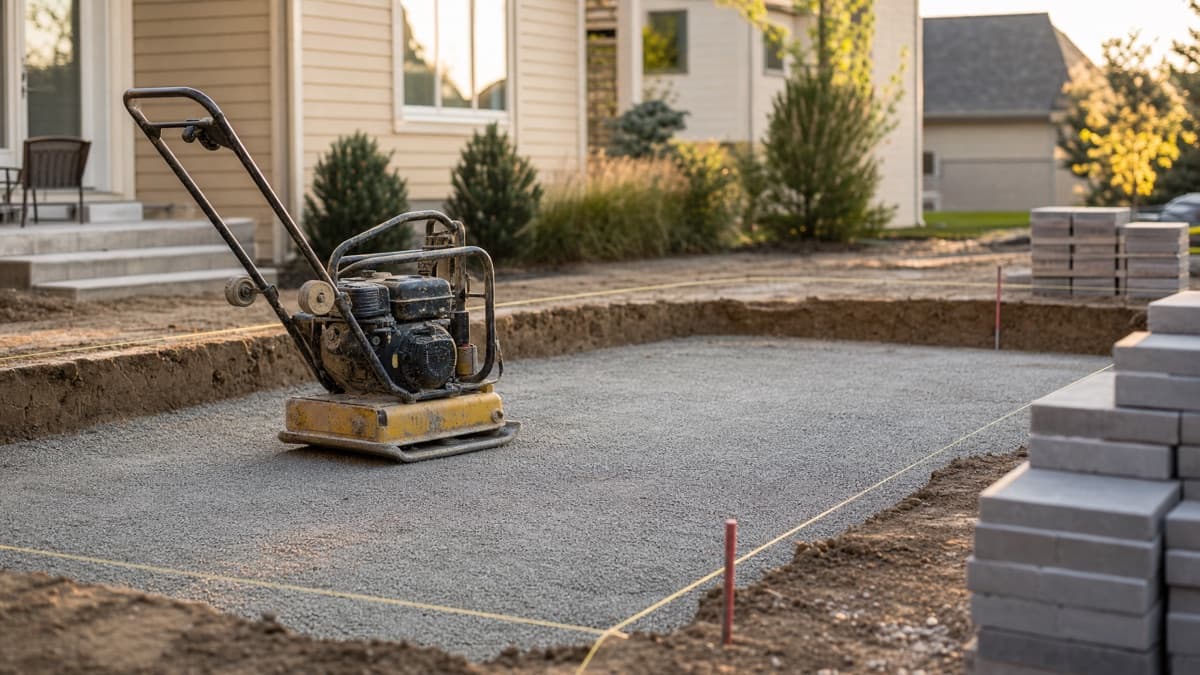
- Whichever you choose, the base is everything. A cheap base under expensive pavers fails just like concrete. Ask any bidder to spec their excavation depth and base thickness in writing.
Thinking Through a Patio Project?
Above the Lawn Services installs paver patios and hardscaping built for Illinois winters — deep compacted bases, quality pavers, drainage done right — across Manhattan, Joliet, New Lenox, and the surrounding area. We'll give you a straight answer about what your yard needs, even if that answer is "a slab is fine here." Call (815) 520-2558 or request a free estimate online.
Get a Free Estimate