On this page
Rock vs mulch comes down to one trade. Rock costs more to put in, lasts for years and is the better choice along foundations, walks and downspouts. Mulch costs less up front and feeds the soil as it breaks down, which makes it the better home for trees, shrubs and perennials, but it needs topping up every year or two. For most Will County front yards the best answer is both: rock where the house and hardscape meet, mulch where the plants live.
River Rock vs Mulch: Side-by-Side Comparison
Here is how the two compare on the questions that actually decide it.
| Factor | Decorative rock | Wood mulch |
|---|---|---|
| Upfront cost | Higher: $85 to $310 per cubic yard installed (river rock) | Lower: $50 to $150 per cubic yard installed |
| How long it lasts | 15 years or more | Topped up every 1 to 2 years |
| Soil and plants | Adds nothing to the soil | Adds organic matter and nutrients as it breaks down |
| Heat | Holds heat; experts differ on how much it warms the soil | Keeps soil cooler and holds moisture |
| Weeds | Few at first, then seeds and dirt blow in | Suppresses weeds at 2 to 4 inches; easier to weed |
| Near the foundation | Stays put under drip lines; termite-resistant | Keep it several inches off siding and window sills |
| Fall leaves | Must be blown out every fall | Raked out, or shredded if left in |
| Changing your mind | Heavy and costly to remove | Easy to plant into or change |
Cost and lifespan figures are national typical ranges from HomeGuide and Fixr, not Above the Lawn prices. Plant and weed points are from Extension sources listed at the end.
Is Rock Cheaper Than Mulch in the Long Run?
Rock costs more on day one. HomeGuide puts river rock at $85 to $310 per cubic yard delivered and installed, and installed mulch at $50 to $150 per cubic yard. The difference is what happens after that: Fixr notes that wood mulch needs topping up every one to two years, while rock lasts 15 years or more.
Here is a ten-year example for a 324 square foot bed (think a 54 by 6 foot foundation bed) at 3 inches deep, which takes 3 cubic yards of either material.
| Cost item | Rock bed | Mulch bed |
|---|---|---|
| Year one install (3 cubic yards) | $255 to $930 | $150 to $450 |
| Weed fabric (material only) | $16 to $81 | Not recommended under mulch |
| Top-ups, years 2 to 10 | Little or none | $200 to $1,350 (4 to 9 refreshes of about 1 yard) |
| Ten-year total | About $270 to $1,010 | About $350 to $1,800 |
Rock: HomeGuide's $85 to $310 per cubic yard for river rock delivered and installed. Mulch: HomeGuide's $50 to $150 per cubic yard installed. Fabric: HomeGuide's $0.05 to $0.25 per square foot. The 1-yard top-up is an assumption for illustration. None of these are Above the Lawn prices.
The ranges overlap, so rock is not automatically cheaper. It pulls ahead when the bed stays the same for years and you would otherwise pay to refresh the mulch. The table also leaves out two things a rock bed needs: the old mulch or sod removed first, and a real edge to hold the rock. And going back is the expensive direction. HomeGuide puts rock removal at $220 to $250 per cubic yard to haul away, before disposal fees.
Pricing the mulch side? Our mulch calculator and cost guide covers quantities and bagged versus bulk prices.
Heat, Soil and Plant Health
This is where mulch earns its keep. The Morton Arboretum explains that as mulch breaks down it adds organic matter to the soil and releases nutrients. University of Illinois Extension goes further and says research shows arborist wood chips give more benefits with fewer drawbacks than other mulch choices. In the clay soil common in Will County, that slow supply of organic matter is worth having around plants.
Rock adds nothing to the soil. Iowa State Extension says inorganic mulches do not improve soil fertility or structure, and that rock warms soil quickly in spring, holds warmth into fall and can keep soil excessively warm in summer. The Chicago Botanic Garden says stone retains heat instead of keeping soil and roots cool.
To be fair, the experts do not all agree on soil temperature. University of Illinois Extension's 2023 mulch guide says research shows rock mulch does not raise summer soil temperatures. Our practical read: rock is fine in open beds with a few tough, sun-loving plants, and the wrong choice over the roots of trees and moisture-loving shrubs. If you mulch around trees, the Arboretum's rule is to pull it back from the trunk in a donut shape and never pile it against the bark.
Weeds: Neither One Is Weed-Free
Rock does not end weeding. University of Illinois Extension says deep stone controls weeds only in the short term: weed seeds and soil blow in, and the weeds that follow can be hard to control without herbicides. Iowa State Extension adds that organic matter and soil gradually build up on top of rock and fabric until weeds can root, and that even river rock gets weeds over time.
Mulch fights weeds a different way. Iowa State says a 2 to 4 inch layer suppresses weeds, and the ones that do sprout pull easily out of loose mulch. Rock, by contrast, makes weeding more difficult. Either way, plan on a little weeding each season.
Rock or Mulch Around the House Foundation?
Along the foundation, rock has the edge. Iowa State Extension says mulch should be kept several inches away from the house foundation, and that mulch covering window sills or touching siding may give termites direct, hidden access into the home. HomeGuide lists rock as termite-resistant.
Water is the other reason. Mulch is light, and a downspout or an overflowing gutter in a heavy spring storm can wash it out of the bed and onto the lawn. Rock stays put, which is why small river rock is a common pick for drip edges under gutters and downspouts.
Whatever goes down, the soil under it should slope away from the house so water runs off, not toward the basement. Never pile rock or mulch against the siding to hide a low spot; fix the grade instead.
Leaves and Fall Cleanup
Rock beds need leaves blown out every fall. Leaves settle between the stones and break down into exactly the layer of organic matter that Iowa State says lets weeds take hold. In yards with big trees, that can mean blowing out the beds more than once before the season is over. White rock shows leaves and dirt sooner than black or gray.
Mulch beds are more forgiving. Leaves can be raked out, or shredded if you want to leave them in, since Iowa State notes whole leaves tend to mat down. If you would rather skip both, our fall cleanup service clears the beds and hauls the leaves away.
Look and House Style
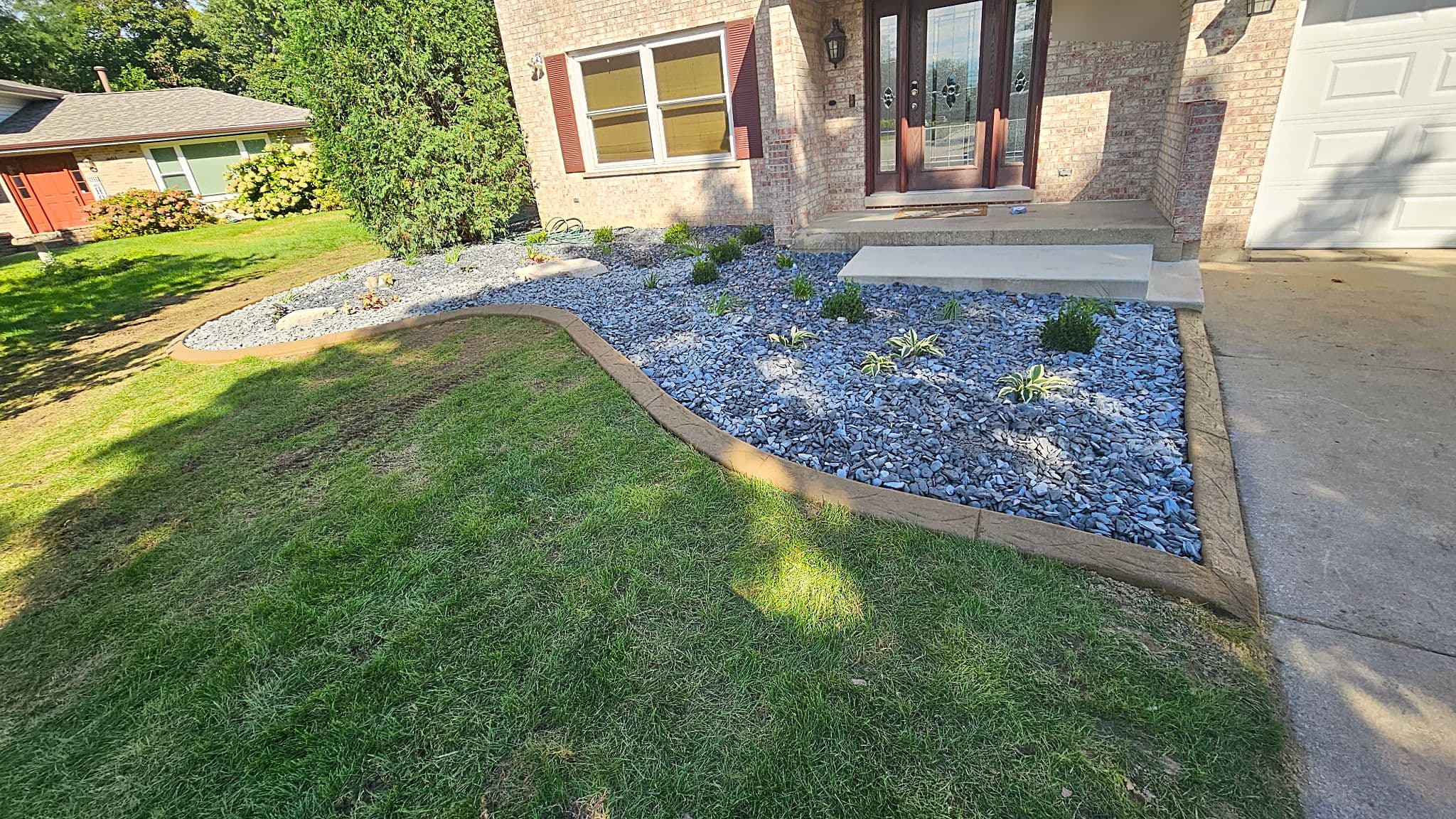
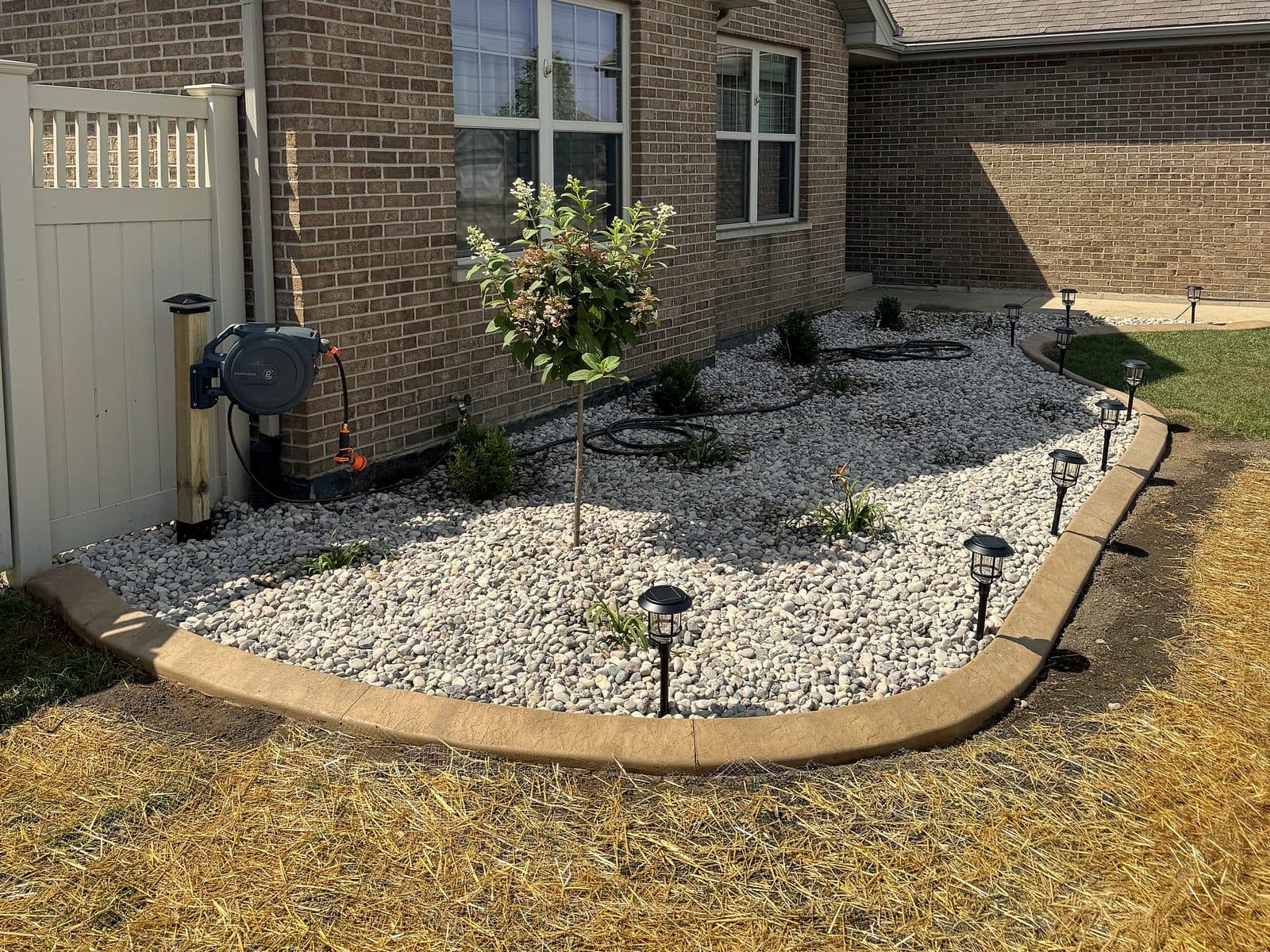
Rock gives a crisp, finished look that stays the same color all year, and the color can be matched to the house: black rock against red brick, white or light gray with tan brick or beige siding, gray or blue-gray with gray brick and stone.
Mulch looks softer and more natural and lets the plants be the star. Fresh mulch looks its best early in the season, then fades and needs a refresh to look sharp again. Neither look is wrong; it comes down to what suits the house and how much upkeep you want.
When to Mix Rock and Mulch
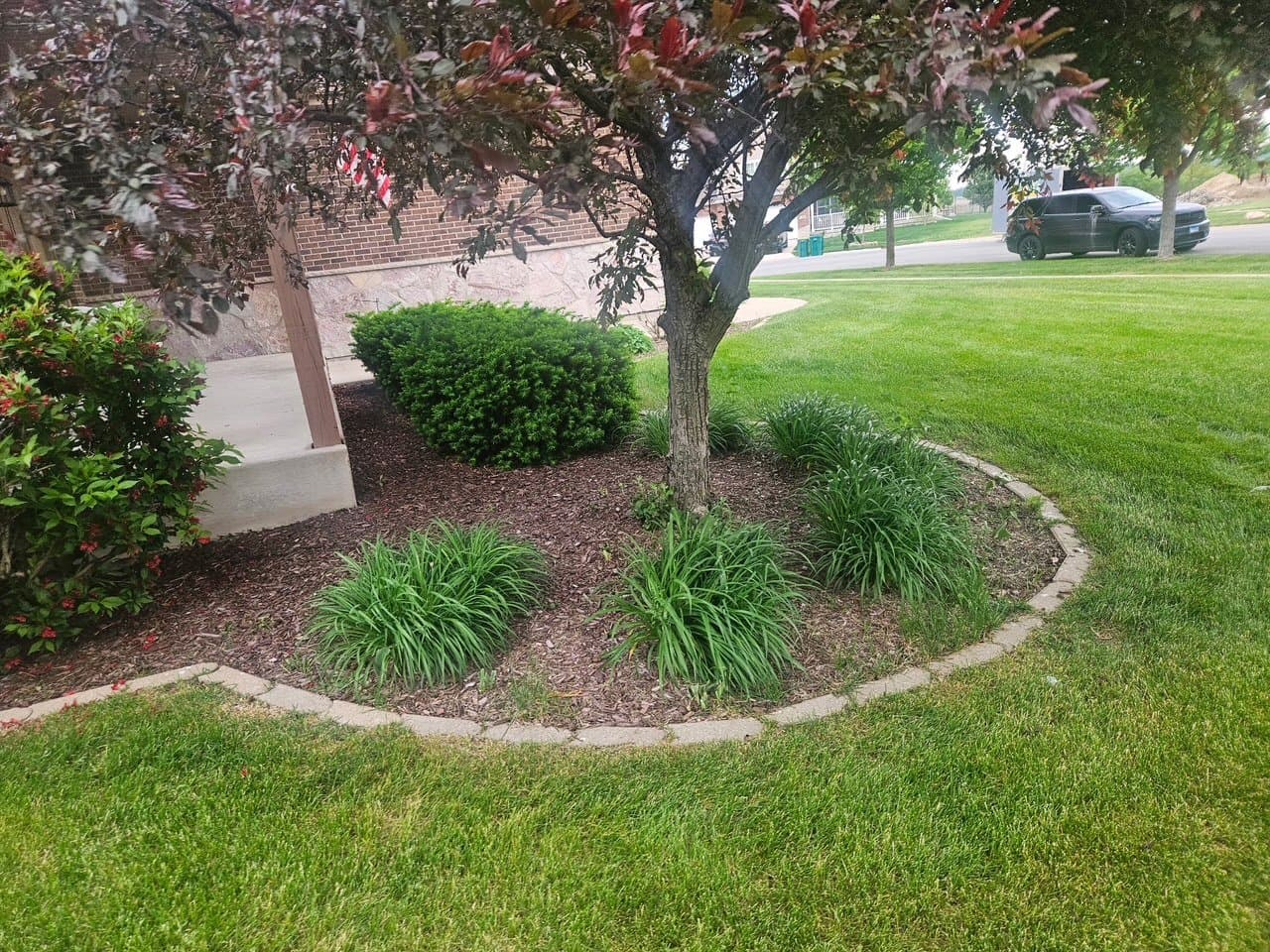
Most yards do not have to pick one. A combination usually works best:
- Rock: a band along the foundation, beside walks and the driveway, under downspouts, and in narrow side-yard strips where little grows.
- Mulch: around trees, in shrub groupings, in perennial beds and anywhere you plan to add or move plants.
Separate the two with a clean border so neither wanders into the other or into the lawn. A poured concrete curb or paver bullet edging does that job. Our landscape edging guide compares the options.
Landscape Fabric Under Rock, Not Under Mulch
Fabric belongs under rock. Iowa State Extension says fabric is used under rock to keep it from mixing into the soil. It is not a permanent weed stop, and it can restrict water and air moving into the soil; University of Illinois Extension calls landscape fabric not ideal for long-term use. Under rock, keeping the stone out of heavy clay is usually worth that trade, and Jake lays fabric under the rock beds he builds.
Under wood mulch, skip it. Iowa State says weeds eventually grow on top of the fabric in the mulch, and mulch on fabric is more likely to wash or blow away because it is not touching the soil. And mulch that never touches the soil cannot feed it, which is the main reason to use mulch.
How Deep Should Landscape Rock Be, and How Much Do I Need?
Two to three inches over fabric is the usual depth for decorative rock, per HomeGuide. That covers the fabric without wasting stone. More depth does not buy lasting weed control, since seeds and dirt land on top either way.
The rule of thumb for quantity: square feet x depth in inches ÷ 324 = cubic yards. One cubic yard covers about 162 square feet at 2 inches or 108 square feet at 3 inches. River rock weighs about 1.2 to 1.35 tons per cubic yard according to HomeGuide, so the 3-yard bed above is roughly 3.6 to 4 tons. For other rock types and bag counts, use our gravel calculator.
Switching From Mulch to Rock
A lot of builder beds in Manhattan, New Lenox, Frankfort and Mokena subdivisions are 20 to 30 years old now, with overgrown shrubs and years of mulch built up. Turning one into a rock bed takes more than dumping rock on top. A proper conversion looks like this:
- Old mulch out. Years of broken-down mulch are close to soil by now. The top layer comes out so the rock sits level with the edge instead of mounding over it.
- Weeds and unwanted shrubs out, roots and all. Leftover roots and stumps leave lumps under the fabric and can resprout.
- Reshape and grade. This is the time to make the bed bigger or change its curves, and to slope the soil away from the house. HomeGuide notes some sites need fill dirt before rock goes in.
- Plants in, fabric down. New low-maintenance plants are placed first, then fabric covers the bed around them.
- Rock, 2 to 3 inches deep.
- A finished edge. A concrete curb or paver bullet edging keeps rock out of the lawn and away from the mower.
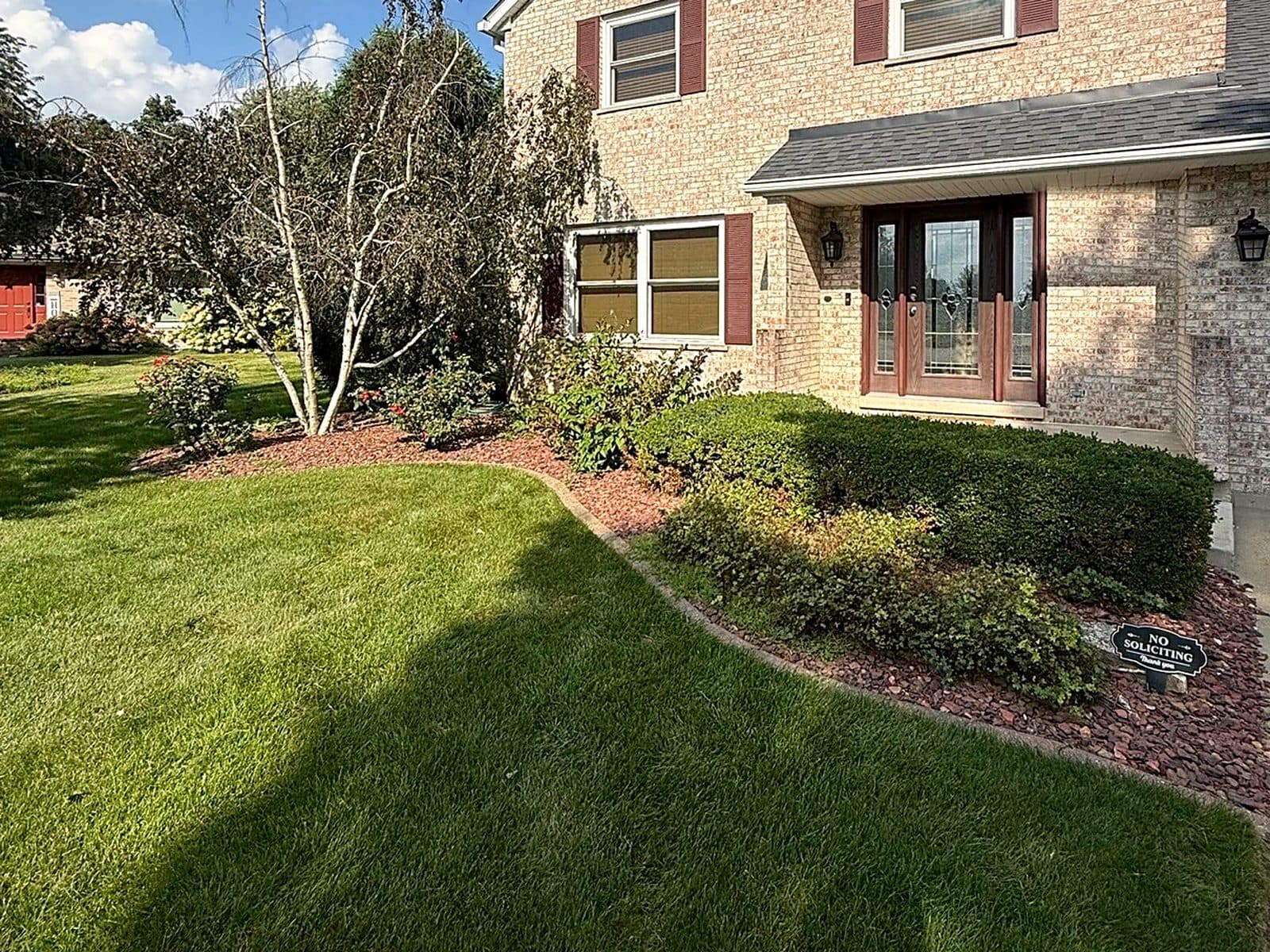 Before
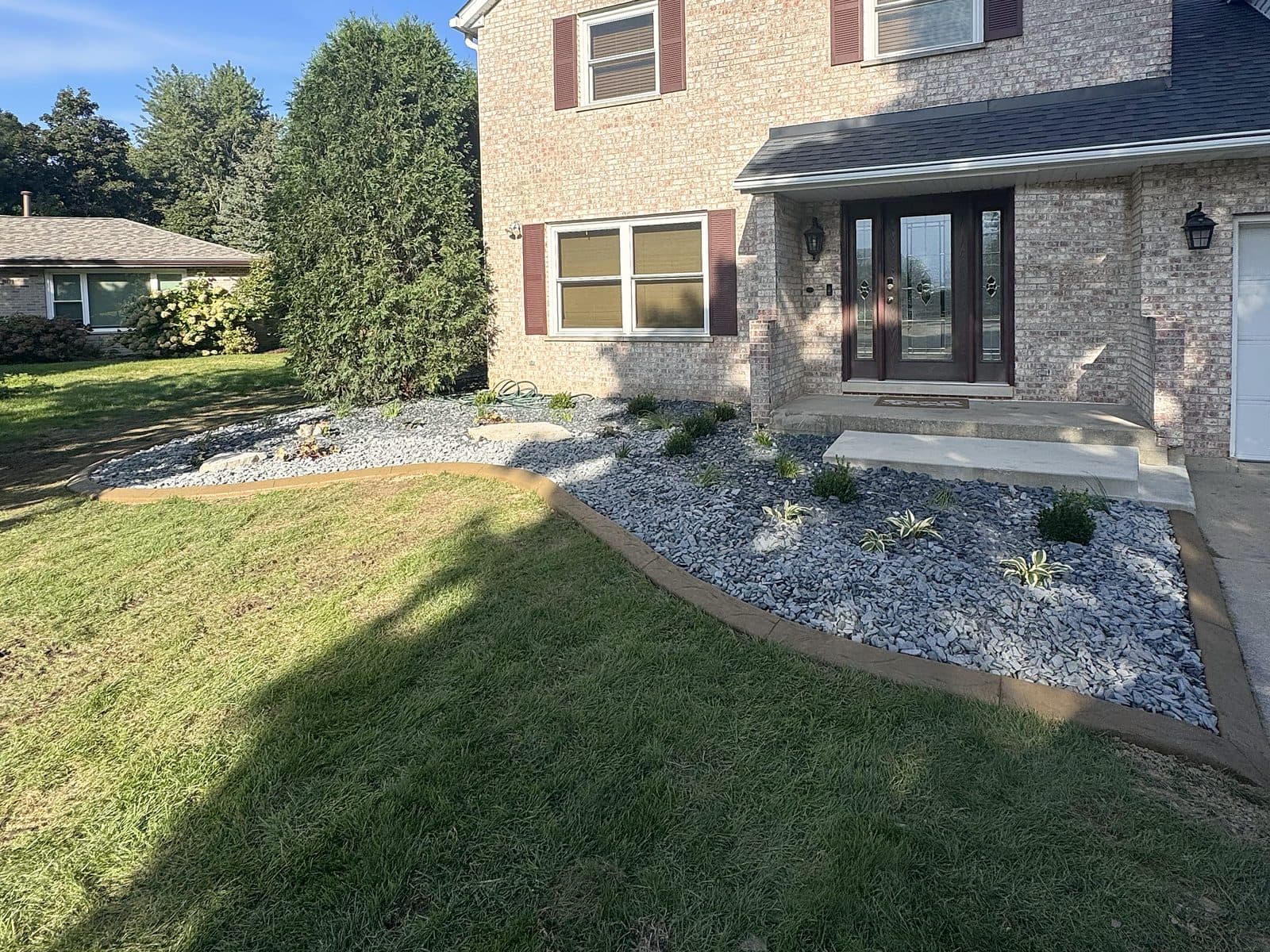 After
That is the kind of conversion Jake does through rock landscaping and landscape bed renovation. Before you commit, remember that rock is the expensive direction to undo.
Rock or Mulch? A Quick Decision Checklist
Choose rock if
- The bed runs along the foundation, a walk or the driveway.
- A downspout or gutter overflow hits the bed in heavy rain.
- The bed holds a few tough plants, or none at all.
- You want the same color year after year and are done buying mulch.
- You are fine blowing leaves out every fall.
Choose mulch if
- The bed holds trees, shrub groupings or perennials.
- You like adding, moving or swapping plants.
- The plants want cool, moist roots.
- The lowest upfront cost matters most.
- You might redo the bed in a few years.
Checked boxes in both lists? That is your answer: rock near the house and walks, mulch around the plants.
Frequently Asked Questions
Is rock or mulch better around a house foundation?
Usually rock. Iowa State Extension advises keeping mulch several inches away from the foundation and off siding and window sills, because mulch touching the house can give termites a hidden path inside. Rock is termite-resistant and stays put under downspouts and gutter drip lines. Whichever you choose, the soil underneath should slope away from the house.
Is rock cheaper than mulch in the long run?
Often, over about ten years. HomeGuide puts river rock at $85 to $310 per cubic yard delivered and installed versus $50 to $150 for installed mulch, and Fixr notes wood mulch needs topping up every one to two years while rock lasts 15 years or more. In our 324 square foot example, rock came to about $270 to $1,010 over ten years and mulch about $350 to $1,800. These are national ranges, not our prices.
Should I put landscape fabric under rock?
Yes, under rock. Iowa State Extension says fabric is used under rock to keep it from mixing into the soil. It is not a permanent weed stop, because dirt and seeds collect on top and weeds root there. Under wood mulch, skip it: weeds still grow on top of the fabric, and mulch that is not touching the soil washes or blows away more easily.
How deep should landscape rock be?
Two to three inches over weed fabric is the usual range for decorative rock, per HomeGuide. That covers the fabric without wasting stone. Going deeper does not buy lasting weed control: University of Illinois Extension notes that deep stone controls weeds only in the short term, because weed seeds and soil blow in on top.
How much rock do I need?
Multiply the bed's square feet by the depth in inches and divide by 324 to get cubic yards. A 324 square foot bed at 3 inches needs 3 cubic yards. River rock weighs about 1.2 to 1.35 tons per cubic yard according to HomeGuide, so that is roughly 3.6 to 4 tons if your supplier sells by the ton. Our gravel calculator does the math for other rock types.
Do weeds grow in river rock?
Some will. Iowa State Extension says even river rock gets weeds over time as organic matter and soil build up between the stones. Most of those weeds start from seed that blows in on top, not from the soil under the fabric. Blowing leaves out every fall and pulling the odd weed while it is small keeps a rock bed looking clean.
Is rock bad for trees and shrubs?
Around trees it is the weaker choice. The Morton Arboretum's tree and shrub mulching advice is built around organic mulch, which adds organic matter and nutrients as it breaks down, and the Chicago Botanic Garden says stone retains heat instead of keeping roots cool. Keep rock to foundation strips and walks, and give trees and shrub groupings wood mulch.
Sources
- University of Illinois Extension, How to Select a Garden or Landscape Mulch (2023)
- Iowa State University Extension and Outreach, Using Mulch in the Garden
- The Morton Arboretum, Mulching Trees and Shrubs
- Chicago Botanic Garden, Mulching Around Trees
- HomeGuide, Landscaping River Rock Prices (December 2025)
- HomeGuide, How Much Does Mulch Cost? (April 2025)
- Fixr, Cost of Landscaping Stones and River Rock (January 2025)
Want Rock, Mulch or Both?
Above the Lawn Services builds rock beds and handles mulch installation in Manhattan, New Lenox, Frankfort and Mokena, IL. Call or text a photo of the bed to (815) 520-2558 for a free quote, often the same day.
Get a Free Estimate